

New on Monday.Trusted by Friday.
Nothing to install and nothing to learn: they in plain language, the account's own answers, and every change they make is before it ships.
One brand on day one. The rest as they earn it.
Onboarding here is a scoping decision, not a training course. You widen the seat as trust builds — and the approval gate never comes off, so the first week carries the same risk as the fiftieth.
Day one · One brand
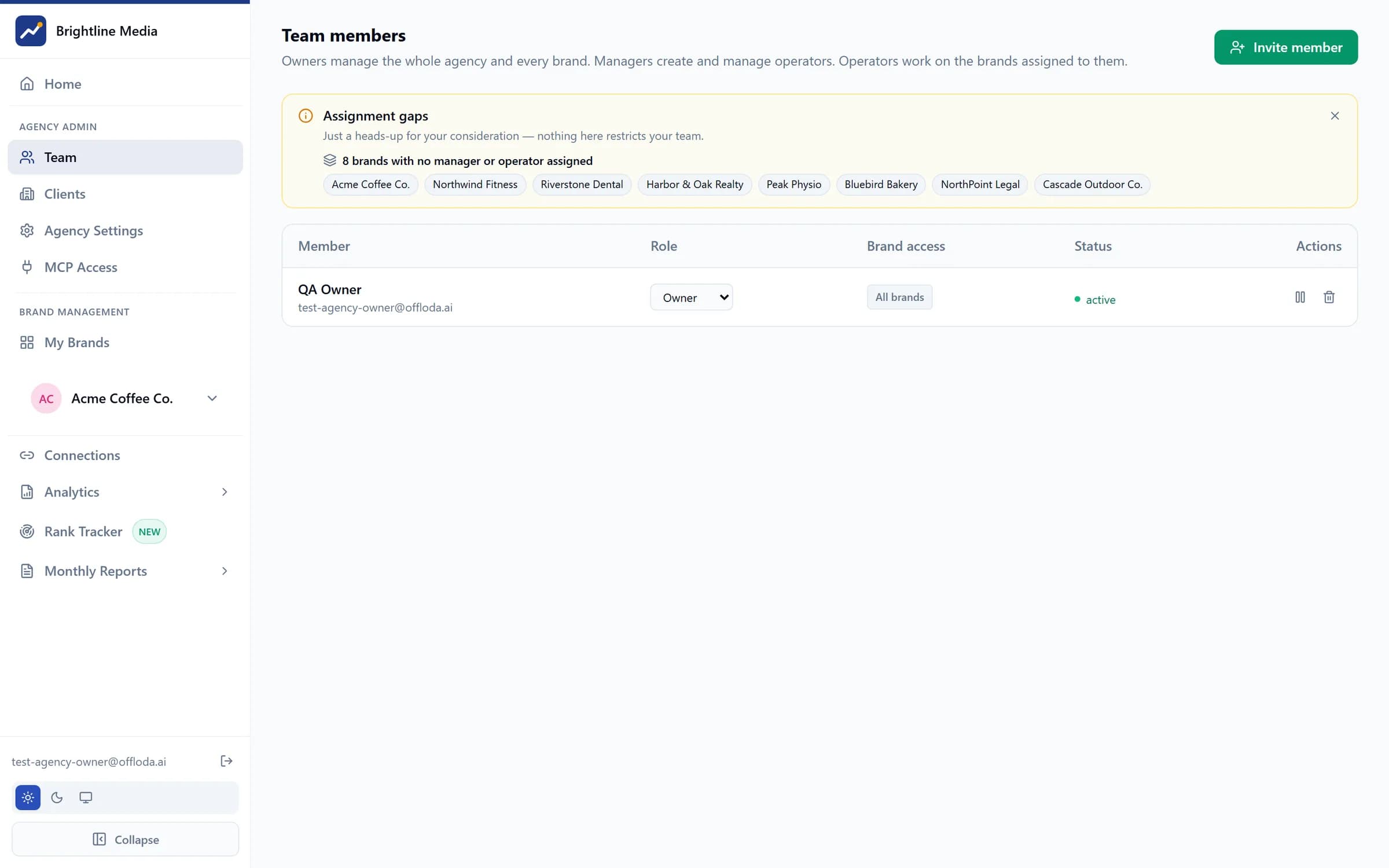
Create the seat, scope it to a single client brand, and pick the platforms it covers. The rest of your book doesn't exist for them — enforced in the database, not by hiding menus.
Day one · Ask anything
They open the AI client your team already uses — Claude, ChatGPT or any MCP client — and start asking. Reading an account needs no training, and reading changes nothing.
Day two · Act, gated
When they act, Offloda shows the exact change before it applies. High-risk changes ask twice. New campaigns start paused. Nothing reaches live spend without an explicit yes.
Week two · Widen it
Add brands and platforms one at a time. Everything they've done is already on the record with their name and the approval beside it — so the review is a read, not an investigation.
Nothing to install, learn or inherit.
Three things normally eat a new marketer's first month: learning the tools, getting access to the accounts, and absorbing what everyone else already knows. Offloda removes all three.
The interface is a sentence
The primary way to use Offloda is to ask for what you want. There's no console to tour, no nested settings to hunt for, and no certification to sit before someone can be useful.
One seat, not twelve logins
No platform invitations to chase, no shared passwords, no waiting on a client to add a user. The connections already live in the workspace; the seat decides what they reach.
The account's history is already written
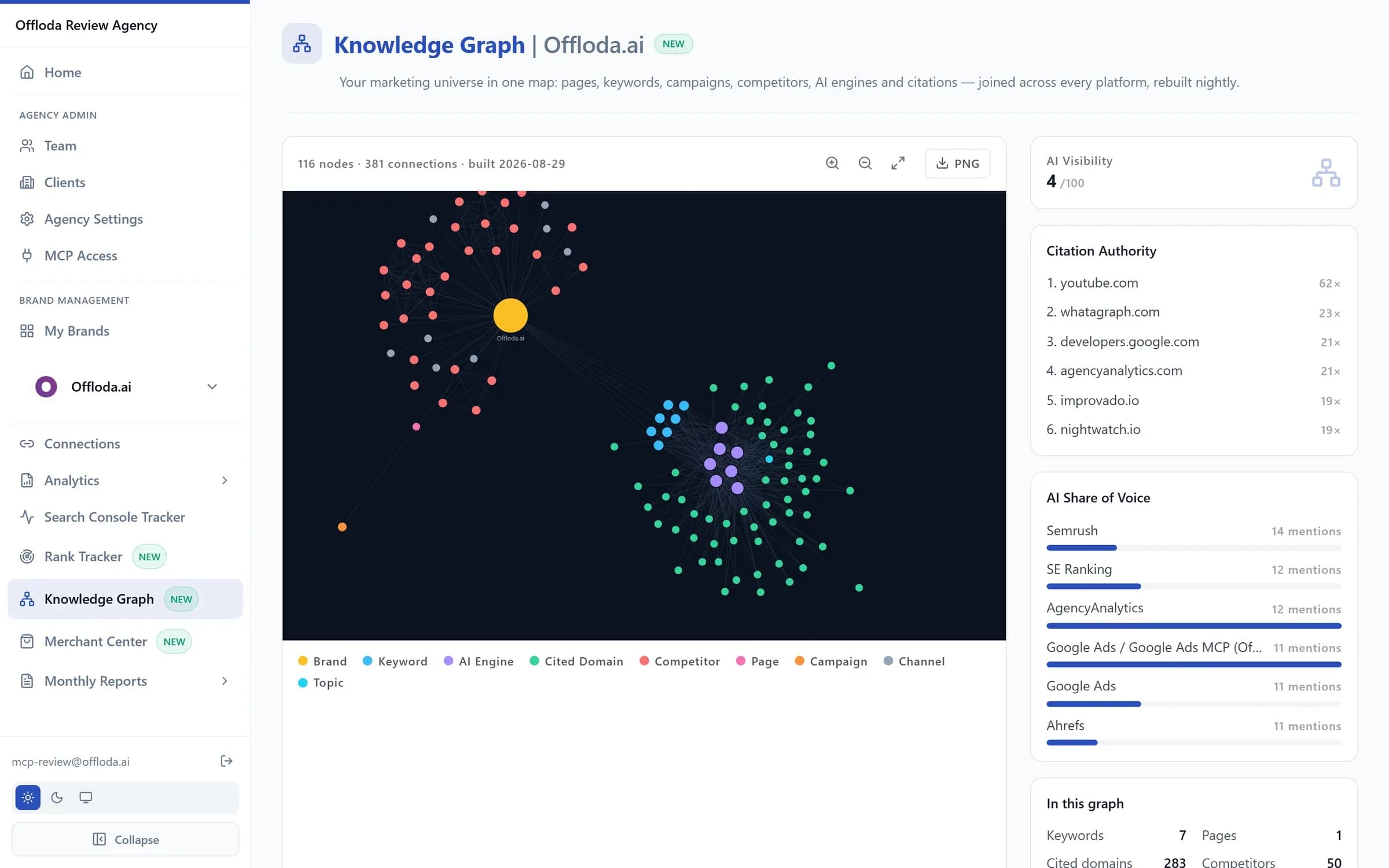
Pages, keywords, campaigns, competitors and AI citations are mapped per brand and rebuilt nightly. A new hire asks the account what's been tried instead of asking the colleague who's in a meeting.
They can't break live spend
Every change is shown before it applies and waits for approval; campaigns are created paused; high-risk actions ask twice. Day-one access carries close to zero day-one risk.
Scoped to exactly one client
Seats are scoped per brand and per platform. A new operator on one account can't see — or touch — anything else you run, so there's no reason to delay their access.
A real deliverable on day one
Ask for last month in plain language and get a branded report out of it. Shipping something useful in the first afternoon does more for a new hire's confidence than a week of shadowing.
Give them the keys to one room.
The usual reason a new marketer waits two weeks for access is that access is all-or-nothing: one platform login opens every account you run. Offloda splits it. Seats carry one of three roles — owners manage the workspace, managers run operations, operators execute — and each seat is scoped to specific client brands and specific platforms within them.
So the honest version of onboarding is: hand them one client and the platforms that client actually uses, watch the record for a week, then widen it. Re-scoping is one change, and the history stays.
- Three roles — owner, manager, operator
- Scoped per client brand, and per platform within it
- Separation enforced in the database, not by hiding menus
- Re-scope or revoke a seat in one change; the history stays
The context that usually lives in someone's head.
When the person who ran an account moves on, the reasoning goes with them. What was tried in March, why the Performance Max test got paused, which terms the client refuses to bid on — none of that lives in the platform, and a handover document never survives contact with the second week.
Offloda keeps a context layer per brand — products, services, audiences, competitors, keywords, locations and voice, and how they connect, updated nightly — with every approved change recorded beside it. A new hire can ask what's already been tried and get the answer, dated, with the person who approved it.
- Ask “what have we already tried here?” and get a dated answer
- Every approved change names who asked and who approved it
- Competitors, citations and keyword history mapped per brand
- Rebuilt nightly, so the answer is never last quarter's
The part they didn't expect.
“Wow. It's the first time I truly understand what is going on in our marketing campaigns with such detail.”
“I just cleared my weekly account checklist by 11am on Monday. I might have to find some new clients to stay busy.”
“I audited our site and fixed 3 issues on Search Console and Key Events missing in Google Analytics that I did not know were missing.”
Onboarding questions
Realistically, how long until a new hire is useful?
The first afternoon, for reading and reporting — asking a question in plain language needs no training, so they can pull performance, find out what changed and generate a branded report the hour their seat exists. Acting on an account is a separate decision you make when you're ready, and the approval gate is what lets you make it early.
Do they still need to learn the ad platforms' own interfaces?
Not to read an account, analyze it, or make the changes Offloda covers. For platform features Offloda doesn't reach yet, and for the occasional piece of deep manual work, the native interfaces still have their place — we'd rather say that than pretend otherwise. What changes is that nobody has to master a console before they can contribute.
What actually stops a junior from breaking something expensive?
Four things, in order: every change is shown as an exact diff before it applies; applying it takes an explicit approval; high-risk changes ask for a second acknowledgement; and new campaigns are created paused. On top of that the seat only reaches the brands and platforms you scoped it to, and every action is on the record.
Can I limit a new seat to one client?
Yes — that's the recommended first week. Seats are scoped per brand and per platform, and the isolation is enforced at the database layer, so the accounts you didn't scope simply don't exist for that seat.
What happens when someone leaves?
Revoke the seat. The platform connections belong to the workspace rather than to the person, so nothing needs reconnecting, and the brand's history — what was tried, what was approved, what happened — stays where it was. That's the part that usually walks out of the door.
Does each team member need their own AI subscription?
Offloda runs on your team's own LLM subscription rather than reselling one, so a new hire needs a seat in your workspace plus access to an AI client your team already pays for — Claude, ChatGPT or any MCP-capable client. If your team shares one surface, that works too.
Their first week, without the first week.
Book a walkthrough and we'll scope a seat the way you'd scope a real new hire — one brand, the gate on, the record open.