

Walk inalready briefed.
the week in one card, then it to your inbox as talking points.
Strategist time, spent like an analyst's.
You're paid to think. The week goes on exports.
Reporting eats the week
The board deck consumes the thinking it's supposed to present. Exports, screenshots, five platform tabs.
An agency's workload, no ops team
Google, Meta, GA4 and Search Console across several accounts — and no analyst, no BI team, no developer behind you.
AI you can't put on a live account
Generic AI drafts ideas and can't touch the account — or could, with nobody checking. Neither is leverage you can stand behind.
Analyze. Strategize. Deploy.
You ask, you approve. The mechanics happen without you.
Ask across accounts
“How did last month go across Google and Meta — and what should change?” One question, every account, live data.
Approve what moves
The plan comes back as concrete changes, each shown before it ships. You approve what moves. The big ones ask you twice.
Show the board the trail
Every action on the record — who asked, what changed, when. A narrative you can defend, not a slide of screenshots.
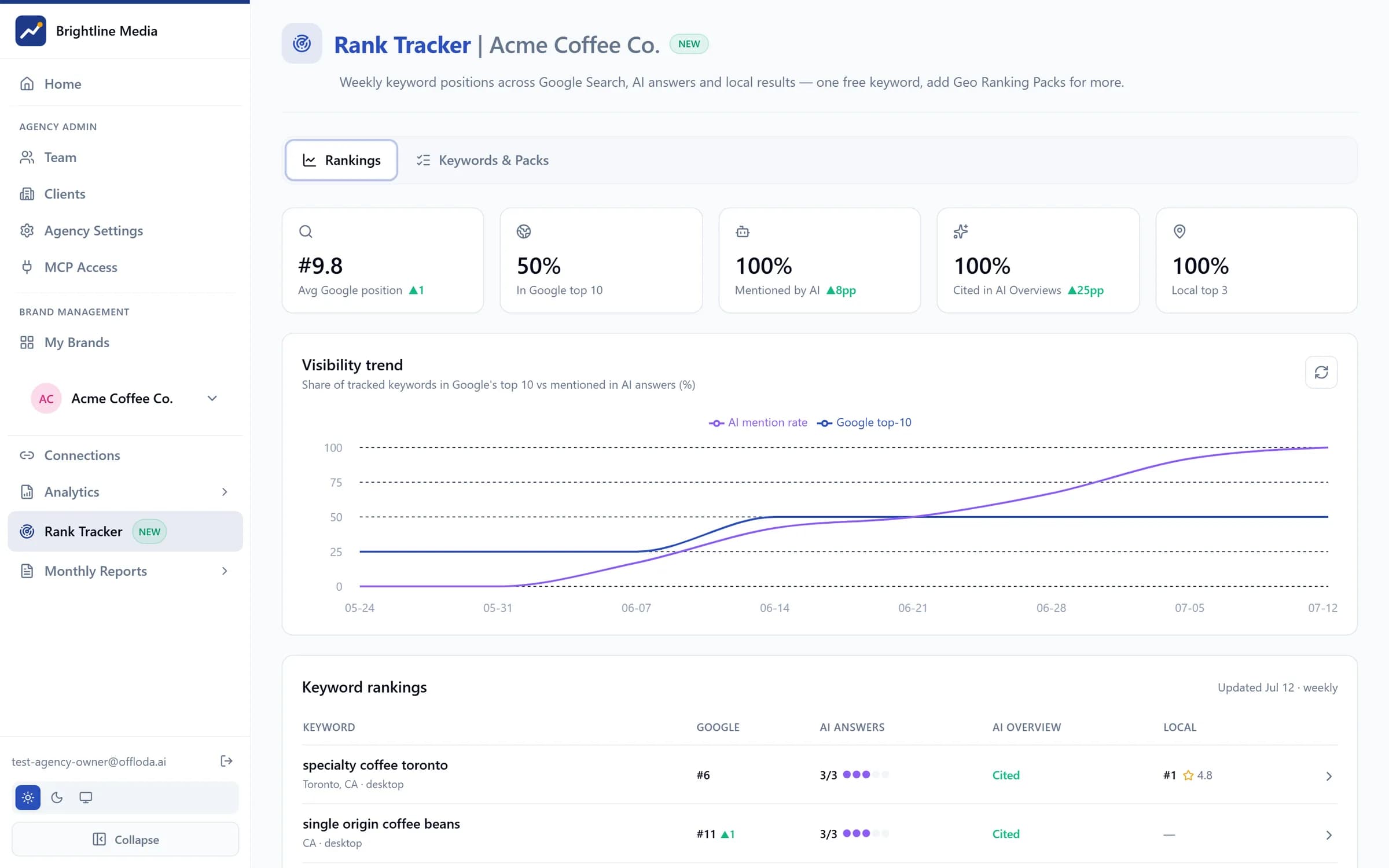
Answer “are we in ChatGPT?” in the same review as ROAS.
The monthly report writes itself from live data, and AI-search visibility sits beside paid performance. Both questions the board asks now, answered from one place.
- Monthly reports in PPT or PDF — no BI team, no designer
- AI-answer visibility across ChatGPT, Perplexity and Gemini
- Paid media down to campaign and ad set
The part they didn't expect.
“Wow. It's the first time I truly understand what is going on in our marketing campaigns with such detail.”
“I just cleared my weekly account checklist by 11am on Monday. I might have to find some new clients to stay busy.”
“I audited our site and fixed 3 issues on Search Console and Key Events missing in Google Analytics that I did not know were missing.”
Fair questions
I'm the strategist, not the button-pusher. Why would I want this?
That's the point. The pulling, the checking and the changing happen in the conversation; you read the change and approve it. You stay at the altitude you're paid for, and the week stops leaking into exports.
I already have an agency, or HubSpot. Does this replace them?
Neither. HubSpot is a CRM; Offloda is the execution layer across the ad platforms, analytics and search. Keep the agency — give them a seat scoped to what they run and keep the approval yourself. What changes is that you can see their work without asking for a deck.
Is it safe to change a live account from a chat window?
Yes, because the chat can't change anything alone. Every change is shown to you as an exact before-and-after; you approve it; the bigger ones ask you twice; new campaigns start paused. Every action is on the record with who asked and when. The AI proposes. You decide.
Do I need a BI team or a developer to get the board deck out?
No. The monthly report generates from live data — Google, Meta, GA4, Search Console — as a PPT or PDF with the narrative already written. It reports on what's connected: a channel that isn't wired in isn't in the deck.
Can it tell me whether we show up in ChatGPT?
Yes, tracked weekly, next to ROAS. Where the brand appears in ChatGPT, Perplexity and Gemini answers, keyword by keyword, and what's earning the citations. Nobody can buy a place in an AI answer; what you get is the measurement, and the fixes drafted for your approval. One tracked keyword is included with every brand; the GEO Rankings add-on is $25 a month per brand for each pack of 10 more.
What does it cost for a team of one?
$125 a month per brand, and your own seat is free. Add a $125 seat for each colleague who works in it, and a $50 read-only seat for anyone who only needs to look — the founder, the agency, the board. No trial: the first month bills at signup, and every change after that is prorated.
Walk into Monday already briefed.
Twenty minutes, your accounts or ours. Watch a question become a change, live.