

Nothing ships withoutyour yes.
Watch the hold: an account-wide change, its exact diff, a second confirmation — and the that undoes it.
Dry-run → confirm → acknowledge-critical.
Three steps, enforced on our servers — not a checkbox in the chat app that a clever prompt can skip.
Dry-run
Every proposed change is checked against the live platform first and shown as an exact diff: what changes, from what, to what.
Confirm
Nothing runs until a person confirms it. No confirmation, no change — on every surface, every platform.
Acknowledge-critical
The changes you can't easily undo ask for a second, explicit acknowledgement on top of the confirmation.
Safe by default.
Campaigns launch paused
Every campaign, ad set and ad Offloda creates starts paused. Going live is always a deliberate act by a person.
Scoped seats
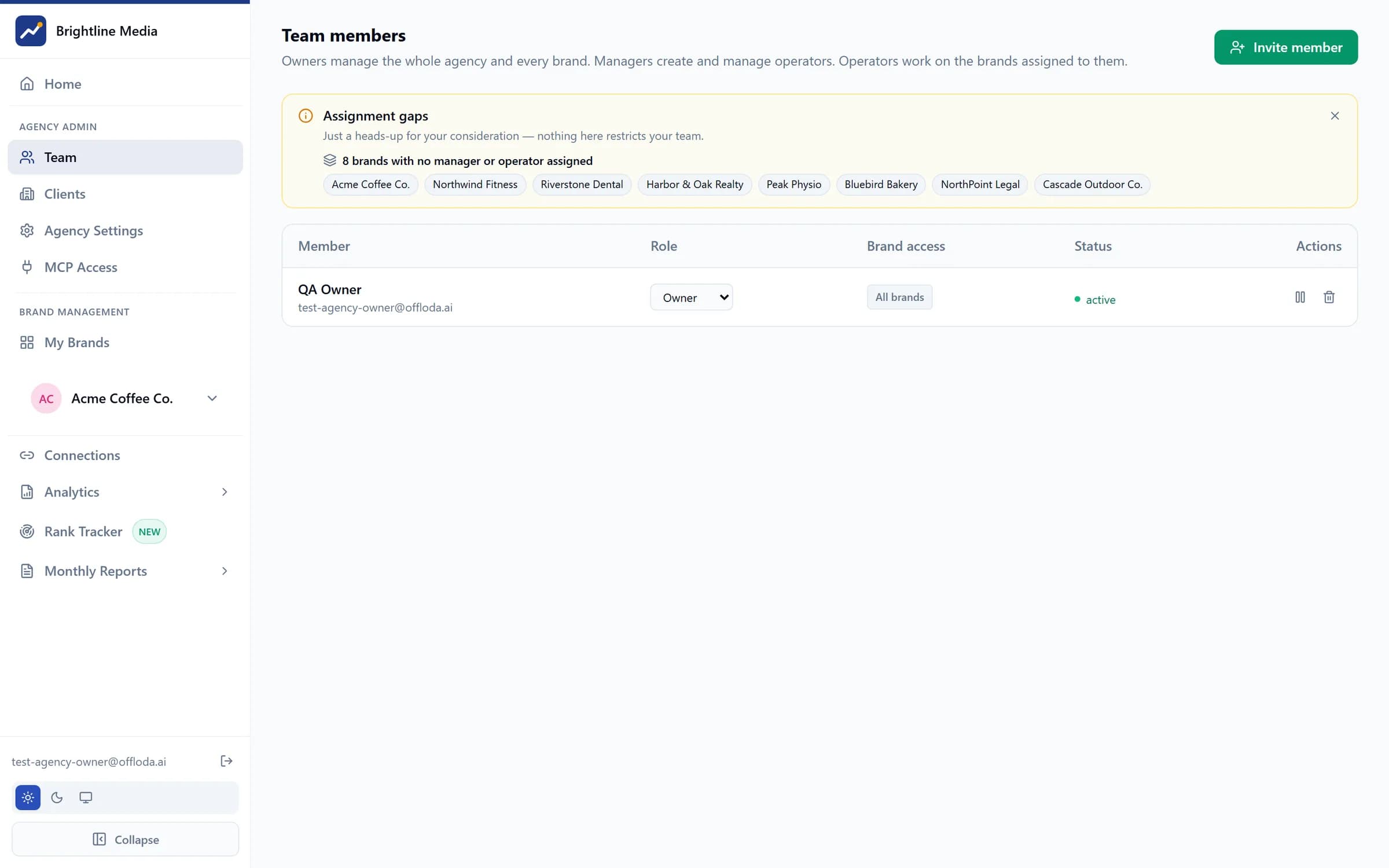
Each teammate reaches only the brands and platforms you've given them — enforced on our side, and the same from every AI client.
Everything on the record
Every read and every write is recorded: who asked, what changed, when it was approved. The record is the trust.
Delegate the work. Keep the decision.
Agencies stall because every risky change funnels through one senior person. With the gate in place, juniors propose and seniors approve — or the AI proposes and anyone approves. The bottleneck becomes a checkpoint, and the checkpoint leaves a record.
- Juniors and AI operate; approval stays senior
- Each seat scoped per brand and per platform
- Every approval on the record for the client conversation
The part they didn't expect.
“Wow. It's the first time I truly understand what is going on in our marketing campaigns with such detail.”
“I just cleared my weekly account checklist by 11am on Monday. I might have to find some new clients to stay busy.”
“I audited our site and fixed 3 issues on Search Console and Key Events missing in Google Analytics that I did not know were missing.”
Approval questions
Can the AI spend money without me?
No. Every budget or bid change is dry-run first and shown as an exact diff; nothing applies until you confirm it. Changes above the threshold you set ask for a second acknowledgement. New campaigns start paused. The AI proposes; a person approves.
Is the gate in the chat app, or in Offloda?
In Offloda. The gate runs on our servers, so it holds identically from Claude, ChatGPT or any MCP client — no client setting can switch it off, and no prompt can talk its way past it. Slack gets notifications only; nothing can be approved from a channel.
What counts as 'high-risk'?
The changes you can't easily walk back. Budget and bid moves above the threshold you set, and any change that's hard to undo, ask for a second, explicit acknowledgement on top of the confirmation. Everything else takes one yes.
Can I undo a change after it ships?
Usually, and you'll always know what to undo. The record holds the exact before-and-after for every change, so reversing one is a change like any other, through the same gate. What can't be undone is money already spent — which is why the riskiest changes ask twice.
Does the gate slow the team down?
One beat, not a bottleneck. Approving a diff takes seconds, and it replaces the review that used to happen after the damage. Reads never need approval, so analysis and reporting run at full speed; only changes stop for a yes. Widen who can approve as trust builds.
Trust is a feature. This is how it's built.
See the gate hold in a live demo — try to break it.